Modernizing Mailjet’s Email Editor
Mailjet’s drag-and-drop email editor sits at the center of the product experience and directly influences onboarding, activation, and retention. While Mailjet’s sending infrastructure remained powerful, research revealed that the editor itself had become a growing source of user friction—not due to missing features, but because its rules, scope, and system feedback were often implicit or hard to trust.
Signals across support tickets, 9,300+ NPS verbatims, usability testing, and competitive benchmarking consistently pointed to breakdowns in clarity and confidence. Users struggled to understand where controls lived, how styling was scoped, what composite blocks allowed, and whether actions like testing or saving had actually succeeded.
At the same time, the market has largely commoditized around similar email editor UI patterns, limiting differentiation through visual design alone. This created a strategic opportunity to compete on brand governance, editing confidence, collaboration, testing visibility, and contextual AI.
This work focused on modernizing the editor as a foundational system, aligning it with user mental models, making scope and overrides explicit, strengthening drag-and-drop affordances, and embedding trust surfaces directly into the workflow. Validation confirmed that reducing uncertainty—not adding power—was the primary lever for improving usability and confidence.
Timeline:
Research and validation ran from Oct–Dec 2025, followed by design partnership, feasibility alignment, and engineering handoff beginning in Jan 2026.
Role:
Lead UX Researcher · Design Partner
I led research from discovery through synthesis and partnered closely with product design to translate insights into validated design decisions. My responsibilities included:
Research strategy and planning
Unmoderated card sorting
Moderated and unmoderated usability testing (wireframes and prototypes)
Competitive benchmarking
Cross-signal synthesis and IA recommendations
Microcopy strategy
Research-informed design guidance and feasibility alignment
Engineering handoff support and documentation
We sought to understand:
How users mentally model blocks and styling
Where styling scope becomes ambiguous
How composite blocks affect speed vs. comprehension
Which interactions create cognitive friction
Whether a tabbed Content | Style | Settings model reduces guesswork
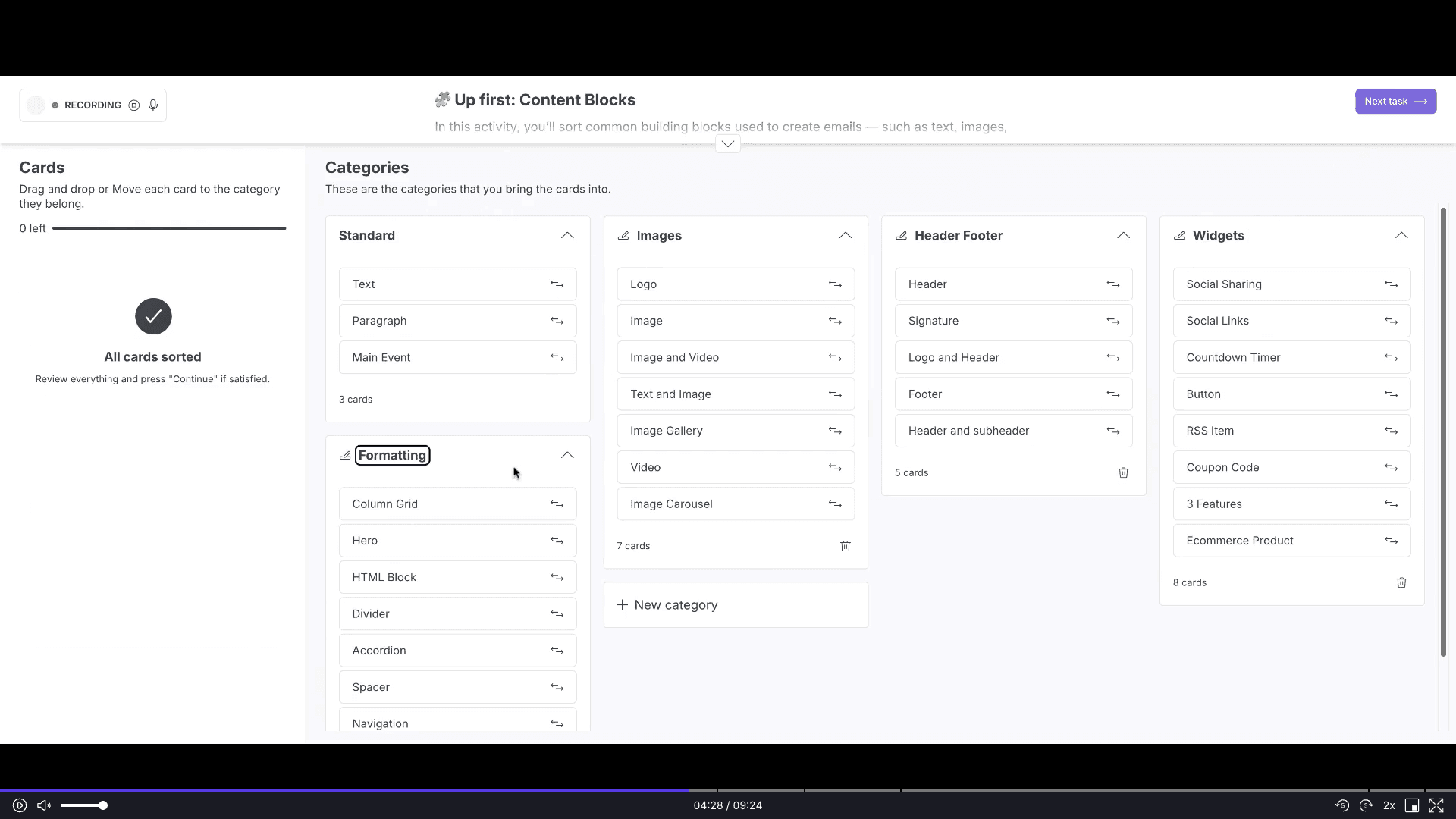
Unmoderated Card Sorting
Two exercises over two weeks evaluated how users grouped 30 content blocks and 20 settings.
Recruitment constraints capped the sample at 12 participants. While larger samples are ideal for statistical clustering, grouping patterns repeated consistently across participants and locales, providing strong directional confidence.
Competitive Benchmarking (12 Tools)
Competitive analysis revealed consistent market gaps in:
Brand enforcement clarity
Collaboration ergonomics
Testing and validation visibility
Embedded AI guidance
Rather than reinventing editor layouts, this reinforced an opportunity to differentiate through brand-safe flexibility, inline trust tooling, and contextual AI co-piloting.
NPS + Verbatim Synthesis (9,300+ Comments)
Recurring friction themes surfaced across customer feedback:
No autosave or versioning
UI instability
Rigid template behaviors
Poor error messaging
These insights directly informed requirements for:
Draft history and recovery
Inline warnings and system feedback
Flexible block reuse
Clear override visibility
Insights were triangulated across verbatims, support trends, and usability observations.
Unmoderated, think-aloud usability tests were conducted using an interactive Figma Make prototype to validate IA, mental-model alignment, and trust-related interactions.
Task Success Highlights
Preview before sending (90% success);
Adjust section background (80% success);
Add subject line (80% success);
Use the AI assistant (80% success);
Reorganize content (70% success);
Change text font (50% success).
Self-reported difficulty: 3.2 / 5 (generally approachable)
Friction most often occurred during mid-flow editing and system feedback moments, not initial discoverability.
When frustration appeared, it was typically tied to unclear system responses or prototype limitations, rather than confusion about what to do next.
Validation focused on confidence and predictability, not just task completion.
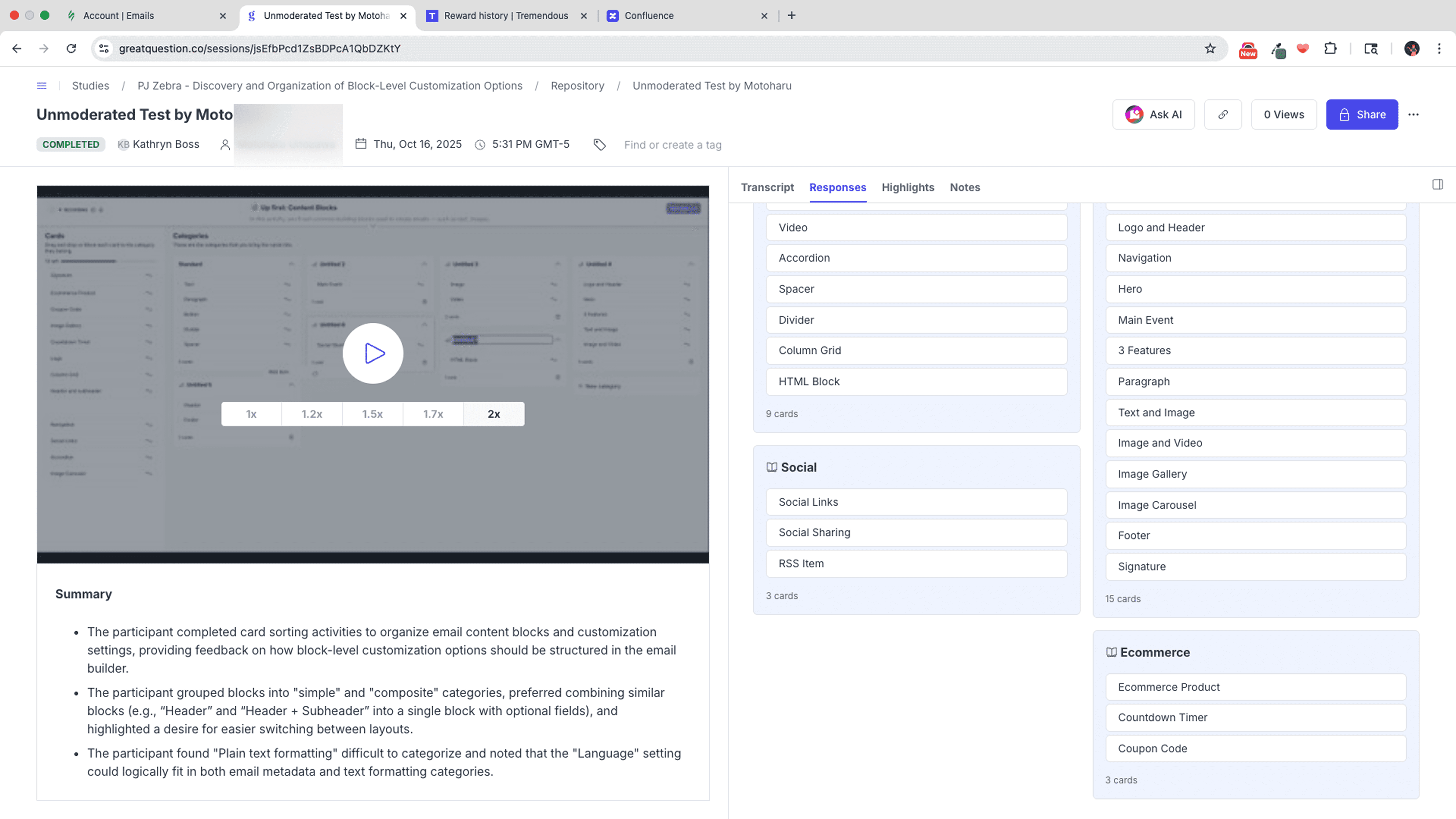
Users Organize by Mental Model, Not Feature Taxonomy
Users grouped blocks by layout, function, or frequency—rarely by system structure.
Implication:
The editor must support multiple mental models through labeling, previews, and contextual cues rather than enforcing a single taxonomy.
Styling Friction Is Driven by Invisible Scope
Users were less overwhelmed by styling options than by uncertainty around where changes applied.
Implication:
Styling systems must make scope visible, reversible, and safe.
Composite Blocks Trade Speed for Confidence
Pre-built blocks accelerated creation but introduced hesitation when editability was unclear.
Implication:
Speed only feels fast when users can predict outcomes.
Mid-Flow Editing Is the Primary Breakdown Point
Reorganizing content and editing in place caused the most friction, especially without strong intermediate feedback.
Implication:
Ghost states, hover previews, and inline feedback are essential for maintaining momentum.
Trust Is a UX Surface
Autosave, testing visibility, error handling, and recovery were perceived as business-critical—not advanced features.
Implication:
Trust must be embedded directly into the editing experience.
Differentiation Comes from Governance, Not Novelty
With market parity in editor layouts, competitive advantage lies in guidance, safety, and extensibility—not visual reinvention.
Tabbed Content | Style | Settings panels aligned to user mental models
Tiered block library (Standard vs. Pre-built) to balance speed and control
Scoped microcopy clarifying styling inheritance
Override indicators to make system behavior explicit
Hover previews and ghost blocks to improve drag-and-drop confidence
Improved visibility of testing history and post-action system feedback
This redesign is actively in engineering handoff.
Hi-fi prototypes in feasibility review
Component audit underway
Microcopy and override patterns being productized
Parallel exploration includes:
Version history and rollback
Comment pins and approvals
All decisions shown reflect research and feasibility alignment as of Q4 2025.
Grounded in mental-model excavation
Differentiates where competitors underperform
Improves perceived reliability through trust UI
Extensible across the omnichannel Passport redesign
Directly addresses churn drivers surfaced in customer feedback

👉 Interactive prototype tested with users during Milestone 3 validation.
High-fidelity validation will focus on:
Scoped styling inheritance
Drag-and-drop placement confidence
Composite block editing flows
Trust panel comprehension
Version history and rollback behaviors
Success will be measured by reduced placement errors, improved override comprehension, and organic discovery of collaboration touchpoints—ensuring users feel confident, not cautious, while editing.
I’m transitioning into a growth-focused UX role across the broader Sinch ecosystem—expanding this work to explore how onboarding, editor experience, embedded AI, platform governance, and cross-product journeys can improve activation, retention, and expansion beyond Mailjet.
Evidence Note
Evidence is drawn from internal usability testing, NPS analysis, and competitive research conducted at Mailjet. Artifacts shown are anonymized.